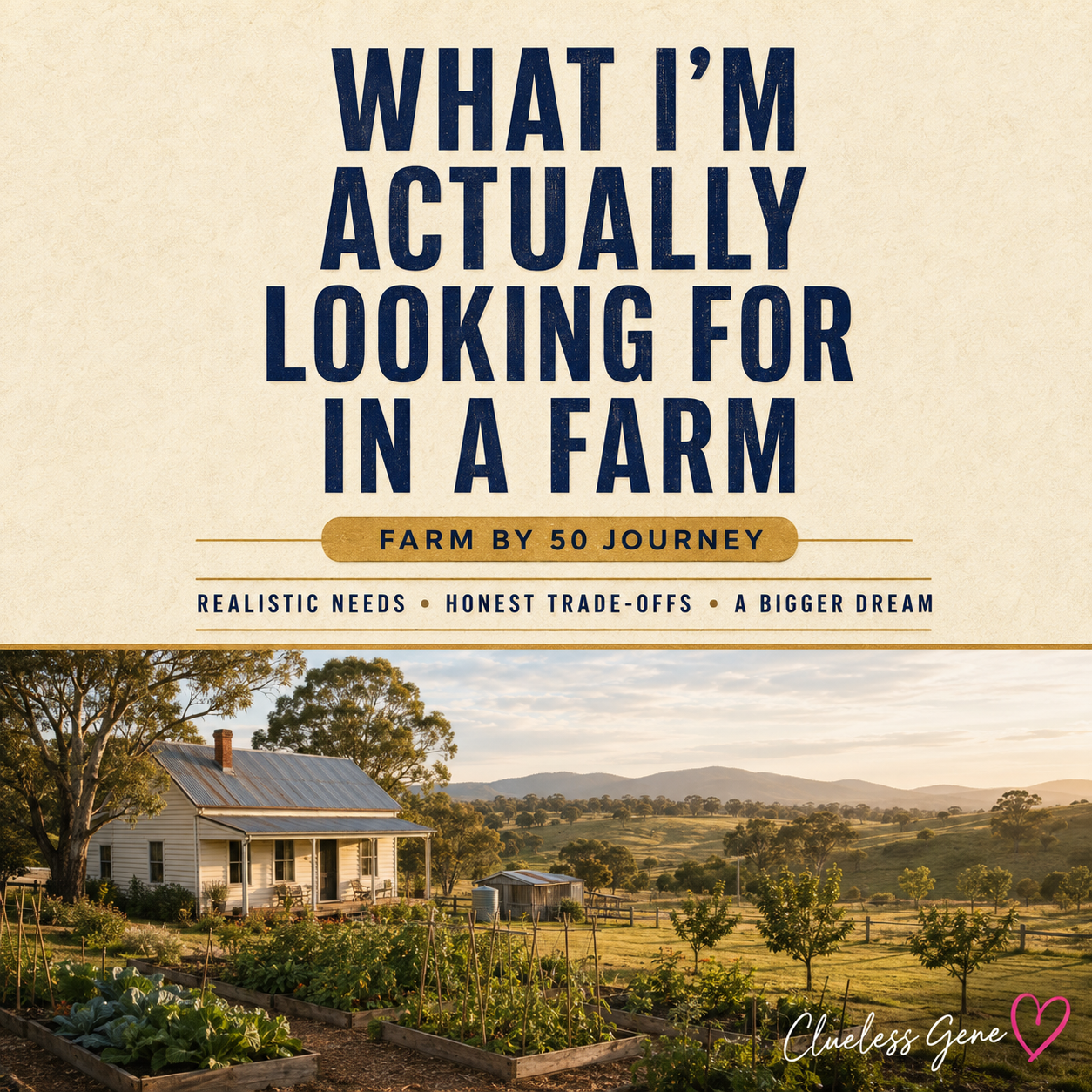
The idea of owning a farm sounds wonderfully simple.
Find a beautiful piece of land, buy it, move in and begin a quieter life.
But property has taught me that the dream shown in photographs and the reality hidden in documents, costs and daily maintenance can be two very different things.
I want to own a farm and celebrate my 50th birthday there in December 2027. However, I do not want to reach that goal by buying the wrong property simply because I am emotionally attached to the deadline.
The farm needs to be more than beautiful.
It needs to work.
WHAT DOES “A FARM” MEAN TO ME?
I am not searching for an enormous commercial operation or pretending that I already know how to manage one.
My version of a farm is a place with enough land to grow things, keep some animals and create a life that feels more connected to nature.
I imagine space, privacy and a home with character. I would like room for projects, outdoor living and perhaps ways of generating income that support the property rather than overwhelm it.
It does not need to be perfect.
In fact, I expect that the right place will need work. Renovation does not frighten me—but unclear ownership, impossible planning restrictions, unreliable water and an unrealistic budget certainly should.
The challenge is separating the problems I can solve from the ones that could consume all my time and money.
LOCATION WILL MATTER
It is tempting to search only according to scenery.
A mountain view, open fields or an old stone farmhouse can make it easy to imagine an entirely new life within minutes.
But a farm is not separate from the world around it.
I will need to consider access to shops, healthcare, transport, building supplies and people who can help with maintenance or repairs. A remote location may offer peace and privacy, but it can also make every ordinary task slower and more expensive.
Climate is another important consideration.
The land may look green and fertile during one season but behave very differently during drought, heavy rain, frost or extreme heat. I need to understand the conditions throughout the year—not only on the beautiful day when I happen to view it.
The country and region may change as I learn more. I am keeping an open mind because the right property may not be where I first expect to find it.
LAND IS NOT JUST EMPTY SPACE
Before this journey, it would have been easy for me to look at land as the attractive area surrounding a house.
Now I understand that the land itself needs as much investigation as the building.
What is the soil suitable for?
Is there a reliable and legal water supply?
Are there drainage problems?
Can vehicles and machinery reach the property?
Are the boundaries correctly recorded?
Are there rights of way, protected areas or restrictions on how the land can be used?
If the finca is in Spain, I would also work through the rural property questions in my Spain buying guide.
A large plot is not automatically more valuable if much of it is inaccessible, unusable or expensive to maintain.
I would rather own a manageable amount of useful land than a vast area that becomes a burden.
THE HOUSE MUST SUPPORT THE DREAM
A romantic ruin can be very persuasive.
So can an inexpensive farmhouse that appears to need only “a little work.”
My experience with renovations has taught me to be suspicious of that phrase.
The condition of the roof, structure, electrics, plumbing, drainage and access can matter far more than the colour of the kitchen or the charm of the original features.
I need a house that can become a comfortable and secure home without swallowing the entire farm budget.
That does not mean I will reject every property that needs renovation. It means the work must be understood, prioritised and priced as honestly as possible before I commit.
I also need to consider whether the house can support the life I want in the future—not only the way I live today.
THE NUMBERS HAVE TO WORK
The purchase price will be only the first number.
There may also be taxes, legal costs, inspections, renovations, equipment, insurance, utilities, land maintenance and ongoing repairs.
An apparently affordable farm can become unaffordable very quickly when all those costs are added together.
I want to understand three figures before making a serious decision:
- What will it cost to buy?
- What will it cost to make the property functional?
- What will it cost to keep it running every year?
I also need an emergency reserve.
Farms, old houses and large pieces of land have a talent for producing problems that were not included in the original plan. If the purchase uses every available euro, there will be no room to respond when something inevitably changes.
POSSIBLE INCOME IS A BONUS—NOT A FANTASY
I would like the farm to have the potential to support itself in some way.
That could eventually involve accommodation, growing something, creating products, holding small experiences or using part of the property for another suitable activity.
But I do not want to justify an expensive purchase using income that exists only in a spreadsheet.
Any income idea needs to survive practical questions.
- Is it legally permitted?
- Is there genuine demand?
- What investment would it require?
- How much time would it take?
- Would it still allow me to enjoy the life I am trying to create?
A possible business opportunity can add value, but it should not be used to disguise a property that is otherwise financially unsustainable.
MY NON-NEGOTIABLES
My exact list will continue to develop, but several priorities are already becoming clear.
- The ownership and boundaries must be properly documented.
- The property must have legal and reliable access.
- There must be a realistic water solution.
- The house and land must be capable of being used for their intended purpose.
- The essential renovation work must fit within the total budget.
- The ongoing costs must be manageable without depending on optimistic income projections.
- And most importantly, the property must move me towards the life I want—not simply give me another complicated project to rescue.
BEAUTY STILL MATTERS
After all these practical checks, I still want to feel something when I arrive.
This is not purely an investment decision. It is a personal dream and, I hope, a future home.
I want to look around and imagine staying.
I want the landscape, the atmosphere and the possibilities to make the hard work feel worthwhile.
The emotional response matters. It simply cannot be the only part of the decision.
Property has taught me that excitement should begin the investigation—not end it.
STAYING OPEN WITHOUT SETTLING
The farm I eventually choose may look very different from the one currently in my imagination.
It may be smaller. It may be in another region or even another country. It may be more modern, less picturesque or closer to a town than I originally expected.
That is not failure.
The goal is not to reproduce a perfect image. The goal is to find a place that is legally sound, financially possible and capable of becoming a meaningful home.
December 2027 gives me something to work towards, but I will not allow a birthday to force a bad purchase.
I would rather celebrate the progress I have made than celebrate on a farm that was bought in panic.
For now, I am learning what to look for, what to question and what I am willing to compromise on.
I still want the view, the land and the sense of possibility.
I just want the documents, water supply and numbers to be beautiful too.