
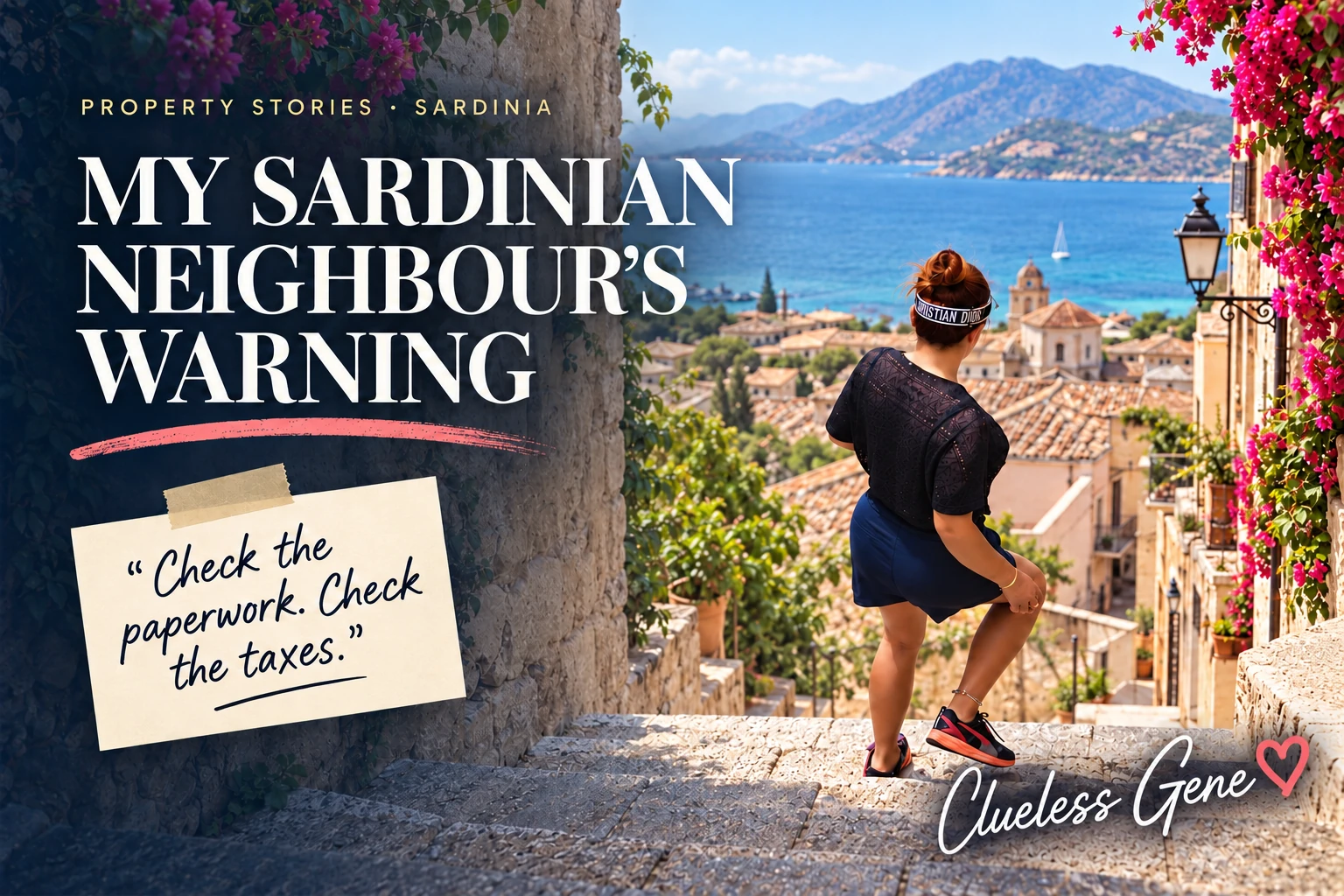
When I first started talking seriously about buying property in Sardinia, my Italian neighbour—who is from Sardinia—didn’t tell me not to buy there.
Quite the opposite.
But there were two things I was warned to pay particular attention to:
The paperwork.
And the taxes.
At the time, it sounded like fairly standard property advice.
Of course you check the paperwork.
Of course you calculate the taxes.
But the more rural properties I look at, the more I understand why that warning mattered.
Read Part 1: Why Sardinia Is One Place I Still Want to Invest.
Read Part 2: The Sardinia Farm That Came With a 2,000 m² Warning.
A farm isn’t just a house with more land
When I’m scrolling through property listings, it’s very easy to see:
A house.
Some outbuildings.
A beautiful piece of land.
Maybe an old ruin.
Maybe somewhere for a pool.
Maybe somewhere I imagine turning into something completely different.
But legally, those things may not all be what I think they are.
What is the land classified as?
Are all the buildings actually registered?
Do the plans match what physically exists?
Was an extension authorised?
Can a ruin really be rebuilt?
Is the access legally documented?
What rights come with water, wells or irrigation?
And, perhaps most importantly:
Can I legally use the property for what I’m imagining?
Those questions matter to me much more than whether I like the kitchen.
The paperwork has to match the property
One thing I wouldn’t want to discover after buying is that the property I walked around isn’t quite the same property that exists on paper.
The Italian Revenue Agency’s home-buying guide tells buyers to obtain as much information as possible, verify that the seller is the legitimate owner and check cadastral and property-register information. It also explains that the notarial deed must identify the filed plans and address whether the physical condition matches the cadastral records.
For me, however, that’s the starting point rather than the finish line.
If I’m looking at rural property, I want to understand every structure and right involved:
- the house
- the storage building
- the ruin
- any extension or pool
- the access road
- the water arrangements
- the land and its classification
Because “it’s been there for years” isn’t the same thing as “it’s legally there.”
And “probably” is not permission.
Then there are the taxes
The advertised price is never the number I really care about.
I’m interested in:
What will this property actually cost me to acquire and own?
The Italian Revenue Agency explains that purchase taxes depend on factors including who is selling and whether the transaction qualifies for particular reliefs. For an ordinary residential purchase from a private seller without the prima casa benefit, its guide describes a 9% registration tax, subject to a minimum, plus fixed mortgage and cadastral taxes of €50 each.
But I’m looking at farms and rural properties.
So I wouldn’t copy a residential example from the internet and paste 9% into my spreadsheet.
I’d want the tax treatment of the actual transaction confirmed.
What is residential?
What is agricultural?
Is everything being transferred under the same classification?
What relief, if any, applies?
What professional and transaction costs should I expect?
What will I pay after I own it?
Those numbers belong in my calculation before I decide whether something is cheap.
“Cheap” is one of my favourite property traps
A €40,000 or €50,000 rural property can look extremely inexpensive compared with property where I live.
But the asking price tells me almost nothing on its own.
Suppose I discover that I need major electrical work.
Or a new septic system.
Or water infrastructure.
Or access work.
Or legal regularisation.
Or structural repairs.
Or that a building cannot be used in the way I expected.
Suddenly my cheap farm isn’t particularly cheap.
This is why I want the all-in number, not merely the purchase price:
Purchase price + taxes + legal/notary costs + technical due diligence + renovation + utilities/infrastructure + furniture/equipment + contingency.
That’s the property I’m actually buying financially.
And then comes my favourite question
What can I actually do with it?
I don’t necessarily look at rural property simply to live quietly in a farmhouse.
I look at potential.
Could part of it eventually produce income?
Could there be accommodation?
Could I create something small and eco-focused?
Could I renovate existing structures?
Could I add anything?
What restrictions come with agricultural or protected land?
The answer may be yes. It may be no.
But I want to know before I price the dream into the property.
There is a huge difference between:
“You can buy this land.”
and:
“You can legally do what you’re imagining on this land.”
My neighbour’s warning makes more sense now
The warning wasn’t that Sardinia is a bad place to buy.
I don’t see it that way at all.
Sardinia remains one of the places where I genuinely hope I will eventually find the right property.
The warning was really about something else:
Don’t fall in love with the property before you understand the transaction.
I can love the view later.
First I want to know:
- Who owns it?
- What exactly is registered?
- What am I legally buying?
- What am I allowed to do with it?
- What will it really cost me?
- Does my position as a foreign buyer change anything?
- What happens if I eventually want to sell?
Those questions aren’t particularly romantic.
But neither is discovering the answer after transferring the money.
This series also made me ask the same question closer to home: can a foreign buyer simply buy any Swiss property that appears for sale? The answer can depend on the buyer, residence status, property and intended use—just as agricultural land introduces a separate layer of questions.
That leads into my Farm by 50 search in Switzerland: different country, different rules, same need to confirm what I can buy and what I can legally do with it.
The legal rules in my Spain Property Buyer Toolkit are specific to Spain. But the working habits behind the Buyer Checklist and Due-Diligence Tracker are deliberately useful anywhere:
Trust. Check. Document.
Then decide whether you still want the property.
This article documents my personal property search and the questions I am asking. It isn’t legal, tax, planning or investment advice. Property classification and tax treatment vary, so an individual transaction should be checked with the appropriate Italian notary, tax adviser and technical professionals before funds are committed.