
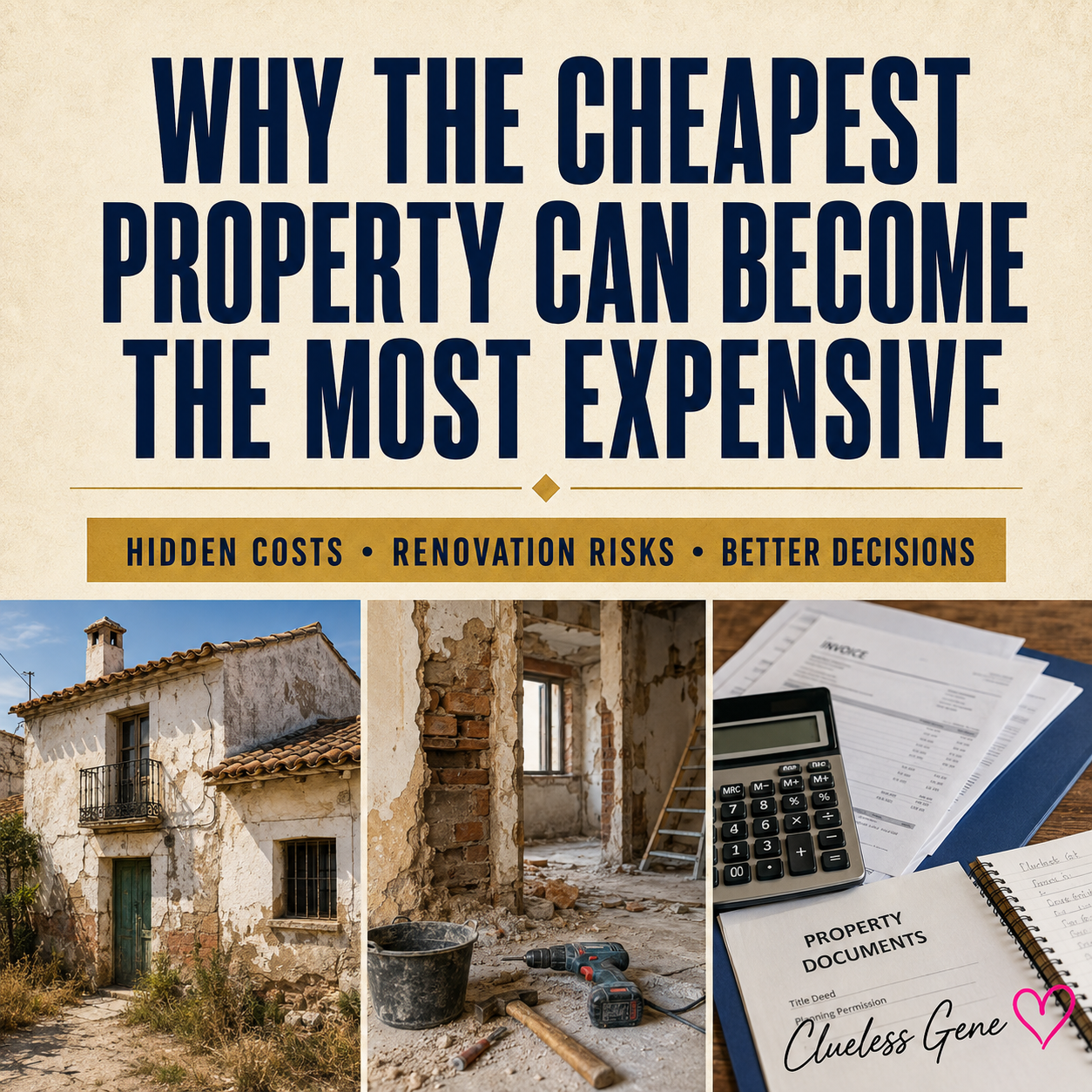
A low asking price can make a property feel like an opportunity—especially when nearby homes appear much more expensive.
But the cheapest property is not necessarily the best deal.
A low price may reflect work, costs or restrictions that are not immediately visible. By the time purchase taxes, repairs, professional fees and ongoing expenses are included, the apparent bargain can cost more than a property that was in better condition from the beginning.
Here are the costs I now investigate before deciding whether a cheap property is genuinely good value.
The asking price is not the total buying cost
The purchase price is only one part of the money needed to complete a property purchase.
Depending on the property and location, buyers may also need to budget for:
- Purchase taxes
- Notary and Land Registry costs
- Legal or administrative assistance
- Mortgage valuation and financing costs
- Surveys or specialist inspections
- Immediate repairs
- Furniture and equipment
- Insurance
- An emergency reserve
A property advertised at €100,000 does not mean the buyer only needs €100,000.
The important question is:
What is the real amount of cash required to buy, complete and safely set up the property?
For the wider buying, running and selling decision in Spain, see my 100 questions about buying property in Spain.
Cheap renovations are rarely as simple as they appear
A property requiring “a little modernisation” can quickly become a major renovation.
Old wiring, plumbing problems, damp, roof damage, drainage issues and unapproved alterations may not be obvious during a short viewing. Once work begins, one repair can expose another.
Renovation estimates also need to include more than materials and labour.
There may be:
- Professional or technical reports
- Licences and municipal fees
- Waste removal
- Temporary accommodation
- Storage expenses
- Delays and additional financing costs
- Replacement of items damaged during the work
- Corrections to poorly completed previous renovations
I always add a contingency rather than assuming the first quotation will be the final cost.
A cheap property may carry expensive documents and legal complications
Some problems cannot be repaired with paint and new flooring.
Before becoming attached to a low price, it is important to investigate whether the property has:
- Unpaid community fees or local taxes
- Charges, debts or restrictions
- Ownership or inheritance complications
- Differences between its physical layout and registered description
- Unapproved extensions or conversions
- Occupancy or possession problems
- Restrictions affecting renovation, rental or resale
A property can look physically attractive while still carrying issues that delay—or completely prevent—the buyer’s intended plan.
The cheaper the property appears compared with similar homes, the more important it is to understand why.
Delays also cost money
Buyers often calculate the renovation itself but forget the financial effect of delays.
If a project takes six months longer than expected, the owner may still be paying:
- Mortgage interest
- Community charges
- Insurance
- Utilities
- Local taxes
- Temporary accommodation
- Storage
- Travel costs
If the plan was to rent the property, delayed completion may also mean lost rental income.
Time is a real project cost, even when it does not appear on a contractor’s invoice.
Low ongoing costs should never be assumed
A cheap purchase can still be expensive to own.
Before buying, I want to know the likely annual cost of:
- Community fees
- Local property tax
- Insurance
- Maintenance
- Utilities
- Property management
- Rental compliance
- Periodic repairs and replacements
A property that is affordable to purchase but expensive to maintain may put more pressure on the owner than a higher-priced property with fewer ongoing problems.
The exit matters before you buy
Even if I plan to keep a property for many years, I still consider how difficult or expensive it may eventually be to sell.
A future buyer may notice the same problems that helped reduce the price today.
I ask:
- Will financing be difficult for future buyers?
- Is the property likely to appeal to a broad market?
- Could unresolved legal or planning issues affect resale?
- Will the renovation cost be reflected in the future value?
- What selling expenses and taxes may apply?
- How much cash might actually remain after selling?
Renovation spending does not automatically create the same amount of resale value.
A €40,000 renovation does not guarantee that the property will become worth €40,000 more.
Compare complete scenarios—not asking prices
When comparing properties, I no longer look at the purchase price alone.
I compare:
- Total cash needed to buy
- Purchase and transaction costs
- Immediate renovation requirements
- Contingency reserve
- Annual running costs
- Possible rental performance
- Downside scenarios
- Estimated selling costs and walk-away cash
Sometimes the cheapest property is still the best opportunity. But that conclusion should come from the numbers and checks—not from the asking price alone.
A genuine bargain is not simply a property that costs less to purchase. It is one whose condition, documents, restrictions, running costs and realistic future value still make sense after everything is included.
That is why I created the Spain Property Buyer Toolkit.
It includes the practical guide, automatic Excel buyer calculators, renovation and due-diligence tools, viewing questions, warning signs and checklists I use to examine the complete decision—not just the advertised price.
Explore the Spain Property Buyer Toolkit at the Buyer Toolkit
IMPORTANT
This article is an educational planning resource based on personal buyer experience. It does not replace independent legal, tax, financial, valuation or technical advice. Property rules, costs and individual circumstances can change. Always verify the relevant information with appropriately qualified professionals before signing or paying.